

Earlier this year, our May Monthly Insight examined what market disruption can reveal about diversification. The closure of the Strait of Hormuz showed how exposures across different countries, sectors and commodities can still share operational dependencies through shipping routes, insurance markets, logistics and working-capital cycles.
Several months on, that same turbulent period offers a complementary perspective. While a portfolio-level analysis evaluates how a collection of exposures behaves collectively under stress, a borrower-level analysis demands a much sharper focus: How exactly does a shift in market conditions ripple through an underlying trade, and at what precise point does that change necessitate a response from the investment manager?
This distinction is critical because a trade finance facility is structurally intertwined with a physical commercial cycle. Goods are sourced, transported, held as inventory, sold and ultimately converted into cash. The financing reflects the expected timing and economics of that process. Consequently, when a shipping route shifts, a delivery takes longer or a customer requires different commercial terms, the effect can move through several parts of the transaction at once.
Truly understanding a borrower therefore requires a granular understanding of how their business actually trades. This includes deep visibility into their suppliers, end-customers, logistics corridors, margin buffers, inventory holding periods, and primary sources of repayment. This operational clarity becomes particularly vital when macroeconomic or geopolitical environments shift after a facility has already been structured and deployed.
From market disruption to transaction risk
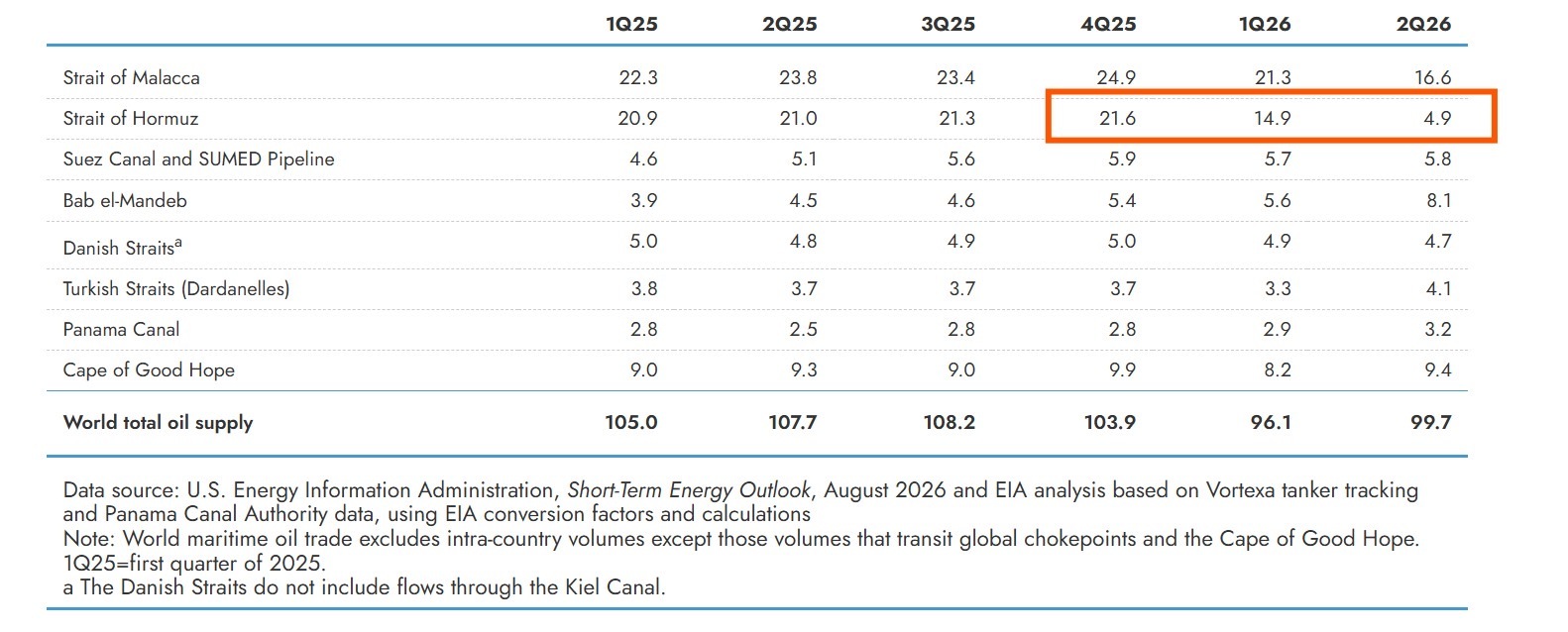
Understanding the true scale of this maritime disruption requires looking at the data, especially since the Strait of Hormuz is one of the most critical energy pathways in the world. Figures from the U.S. Energy Information Administration show that total oil flows through the Strait averaged 21.6 million barrels per day in the final quarter of 2025, after which volumes dropped to 14.9 million barrels per day in the first quarter of 2026, before falling further to just 4.9 million barrels per day in the second quarter.
The broader consequences went far beyond a simple drop in the volume of oil moving through the channel. Reports from the International Monetary Fund showed that daily tanker crossings collapsed from around seventy vessels to near zero after hostilities began, a shift that immediately caused maritime insurance premiums to jump, forced ships to take much longer alternative routes, and pushed up global freight costs.² Later analysis by UN Trade and Development confirmed that these problems around the Hormuz corridor increased energy, transport, logistics, and production costs across global supply chains.³
For a trade finance portfolio, these big macroeconomic problems matter because they change the reality of individual transactions. When ships are forced to take longer routes, goods spend more days in transit, which naturally extends inventory holding periods and ties up more working capital in a single trade. At the same time, higher transport costs squeeze profit margins, whilst delayed deliveries can force businesses to change the commercial terms they originally agreed with their buyers.
The path connecting a geopolitical event to a specific financial risk runs directly through the day-to-day operations of the underlying trade. This process is clearly shown by the experiences of two separate borrowers who were both operating in the same region and living through the same period of disruption. Even though both businesses faced identical external challenges, the unique structure of their operations meant the crisis affected them differently, which ultimately led to very different financing requirements.
Borrower 1: Adapting to a longer trade cycle
The first case study involves a UAE-based supplier of petrochemical and oil industry inputs that specialises in the critical chemicals required for upstream oil and gas extraction. This business operates by importing chemical products and sourcing refinery by-products to supply major oil producers across several key regional markets, including the UAE, Iraq, and Kuwait.
When the regional conflict began to impact local oil production and international trade flows, major oil producers in these markets declared force majeure, which immediately suspended key supply contracts. This sudden disruption broke the borrower’s established sourcing and logistics networks, forcing the Alteia management team to find alternative operational pathways to keep the trade flows moving.
To resolve these bottlenecks, the borrower in conjunction with Alteia sourced new chemical suppliers across Europe and also created entirely new logistics routes to bypass the affected zones. Some products were shipped directly from Europe towards the Middle East, whilst other cargo flows were rerouted securely through Oman and transported by road across the UAE before onward shipment to end-buyers in Iraq and Kuwait.
Although these operational adjustments successfully allowed the borrower to maintain its supply chains, they significantly altered both the timing and the fundamental economics of the underlying trade. Transit took much longer, transport costs escalated, and physical inventory remained locked within the trade cycle for extended periods, meaning the commercial assumptions that formed the basis of the original financing structure were no longer valid.
The borrower addressed part of that change through its commercial relationships, repricing and revising contracts with off-takers to reflect the new operating environment. Alteia addressed the financing side by changing the facility structure to accommodate the longer inventory and logistics tenors created by the revised trade cycle.
Following the implementation of these collaborative structural changes, regular trade flows have successfully resumed under the new framework.
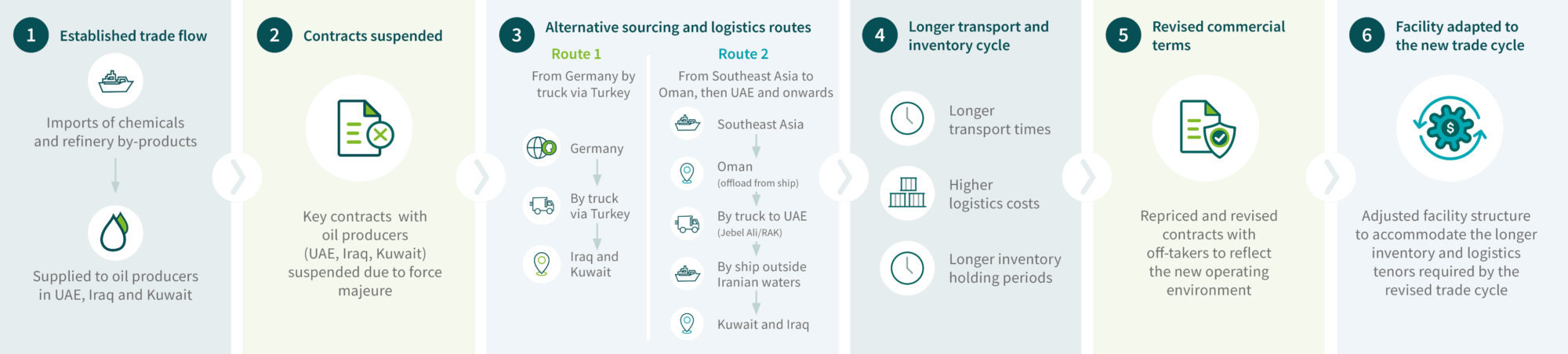
This scenario demonstrates exactly how a single operational shift ripples through a structured trade finance transaction. A change in the physical shipping route alters transport times, longer transport extended the inventory holding cycle, and that longer cycle ultimately changes the working capital requirement. Consequently, credit facilities must always be evaluated and structured according to how a business actually trades in the present market reality.
Borrower 2: Adapting to changing trade flows
The second case study involves another UAE-based petroleum products and shipping company that purchases refined petroleum products from local UAE producers to supply diverse buyers across the GCC and India.
The regional disruption impacted this business through its maritime shipping networks and customer relationships, as several critical shipments faced immediate delays and specific cargo vessels became stranded within the blocked Strait of Hormuz. In India, off-take buyers had already accepted the commercial documents for goods on the water that were subsequently delayed, which meant the commercial credit terms extended to those specific customers had to be prolonged.
To manage this complex situation, the borrower in consultation with Alteia proactively reduced its high-risk export trades and shifted its strategic focus toward domestic and regional trading activities across the UAE, Saudi Arabia, and Oman. This pivot into alternative trade corridors created a very different financing requirement from the extended inventory cycle observed in the first case study.
Alteia also accommodated this strategic shift by amending the credit facility to finance domestic gas oil trades through a structured, Shariah-compliant framework. This revised financial arrangement was supported by rigorous daily oversight of truck transport and cash movements, which provided the investment team with absolute visibility over both the physical movement of the commodities and the associated cash collections.
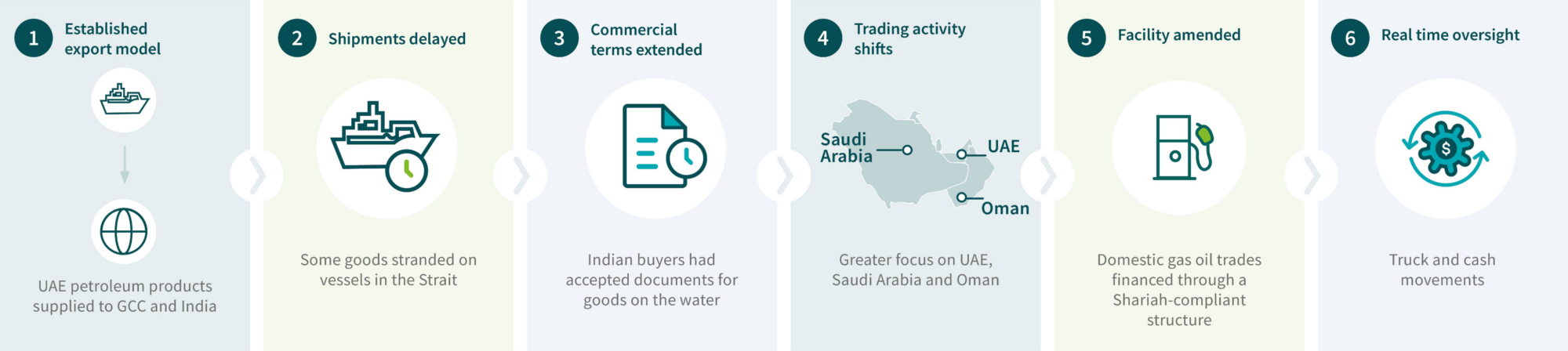
These operational modifications allowed the borrower to continue operating in profitable corridors with reliable counterparties, sustainable demand and margins, while accommodating its longstanding Indian customers as conditions evolved.
Two borrowers, two financing responses
The clear distinction between these two corporate experiences highlights a fundamental lesson for structured trade finance, demonstrating how the first borrower maintained its original trade corridors by accepting a longer logistics and inventory cycle that required the credit facility to adapt by accommodating longer tenors, whilst the second borrower shifted a significant portion of its trading volume toward entirely different geographic corridors in an operational change that demanded a completely different financing structure alongside a monitoring approach tailored precisely to the new domestic trade flow.
These contrasting cases illustrate a highly practical feature of active trade finance management, proving that structured financing must always remain dynamically connected to the physical commercial activity it supports.
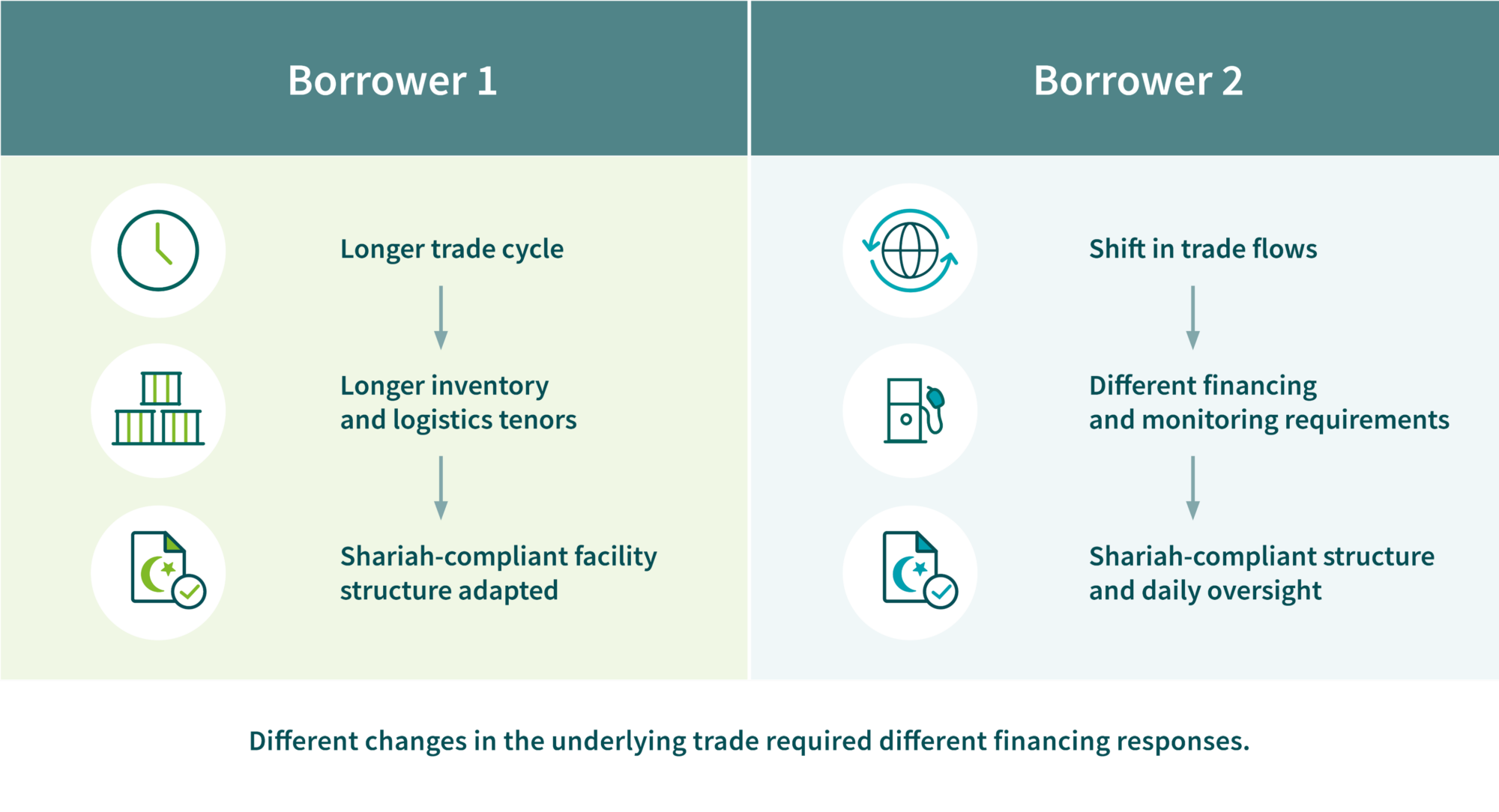
Maintaining that vital connection requires deep operational visibility, meaning that regular communication with borrowers helps the investment team understand operational changes as they occur, whilst thorough knowledge of suppliers, off-takers, shipping routes, inventory periods, profit margins, and cash flows helps determine exactly what those changes mean for the underlying transaction.
The legal framework forms an essential part of this same adaptive process, because major shifts in transit routes, commercial counterparties, or overall transaction structures can quickly affect documentary requirements and security arrangements, all of which may need to be thoroughly reviewed and refreshed as the underlying trade evolves.
Effective portfolio monitoring must also reflect how each transaction operates in real time, as seen in the second borrower example where the strategic move towards domestic gas oil trades was accompanied by rigorous daily oversight of truck and cash movements, ensuring the monitoring approach followed the precise mechanics of the revised trade and not remained fixed around previous activities.
This operational agility is where deep borrower knowledge becomes an indispensable part of risk management, because while a major market event may be visible to the entire public at the same time, its actual implications for an individual financing exposure depend on much more specific, granular information about the inner workings of the transaction itself.
Beyond geography
For investors, this analytical distinction becomes particularly relevant when assessing emerging markets that may carry a higher perception of geographic or geopolitical risk. While general geography provides useful information about where a specific credit exposure physically sits and the external conditions to which it may be exposed, it ultimately provides only a fraction of the total picture because the precise architecture of the underlying trade determines exactly how those external conditions reach the transaction.
The exact same regional disruption can extend inventory holding periods for one borrower, alter delivery timelines and commercial covenants for another, compress profit margins elsewhere, or require a swift change in sourcing, counterparties, and logistics routes. These operational differences only become visible through granular, transaction-level understanding and continuous, ongoing engagement with the borrower.
This reality brings the analysis back to the broader portfolio perspective discussed in our May insight, which showed how a common macroeconomic shock can reveal hidden connections between exposures that appear perfectly diversified on paper. The two case studies presented here show the next layer of that same risk-management process, demonstrating that once a shock reaches an individual borrower, the investment manager needs to understand exactly where it is entering the trade, what it changes physically, and whether the established financing and monitoring approaches remain appropriate.
The short-duration nature of trade finance inherently provides structural opportunities to respond as individual transactions naturally turn over, but exploiting that flexibility depends entirely on the quality of the information available and the manager’s deep understanding of the underlying commercial activity. The physical trade, the legal contractual structure, the financing framework, and the ongoing monitoring process all need to remain tightly aligned as market circumstances evolve.
Global markets shift, shipping routes change, and commercial terms adapt, meaning that understanding how these variations move through the underlying trade gives the investment manager the precise information needed to accurately assess their implications for the overarching financing facility. Geography simply tells an investor where an exposure sits, whilst the underlying trade demonstrates how changing market conditions actually reach it, an operational gap that only active management can bridge.
References
1. U.S. Energy Information Administration (EIA). Short-Term Energy Outlook: Energy Security, August 2026. EIA analysis based on Vortexa tanker-tracking data. Total oil flows through the Strait of Hormuz averaged 21.6 million barrels per day in Q4 2025, 14.9 million barrels per day in Q1 2026 and 4.9 million barrels per day in Q2 2026.
2. International Monetary Fund (IMF). Regional Economic Outlook Update: Middle East and Central Asia, April 2026. Analysis of regional trade and transport disruption, including tanker crossings, maritime insurance premiums and shipping costs.
3. UN Trade and Development (UNCTAD). Global Trade Update, July/August 2026. Analysis of the effects of disruption to shipping through the Strait of Hormuz on energy, transport, logistics and production costs.
About the borrower examples
The borrower examples presented in this Insight are drawn from Alteia’s direct transaction management and portfolio oversight during the 2026 regional disruption period. Identifying details have been limited to preserve client confidentiality.
Explore more Monthly Insights and subscribe to our newsletter on the Alteia Group website.
Further information
If you would like to continue the conversation or learn more about Alteia’s approach to trade finance, you are welcome to connect with us on LinkedIn or reach out to the team at contact@alteiafund.com or infoksa@alteiafund.com.
Any discussion is informational in nature and subject to applicable regulatory and compliance considerations.